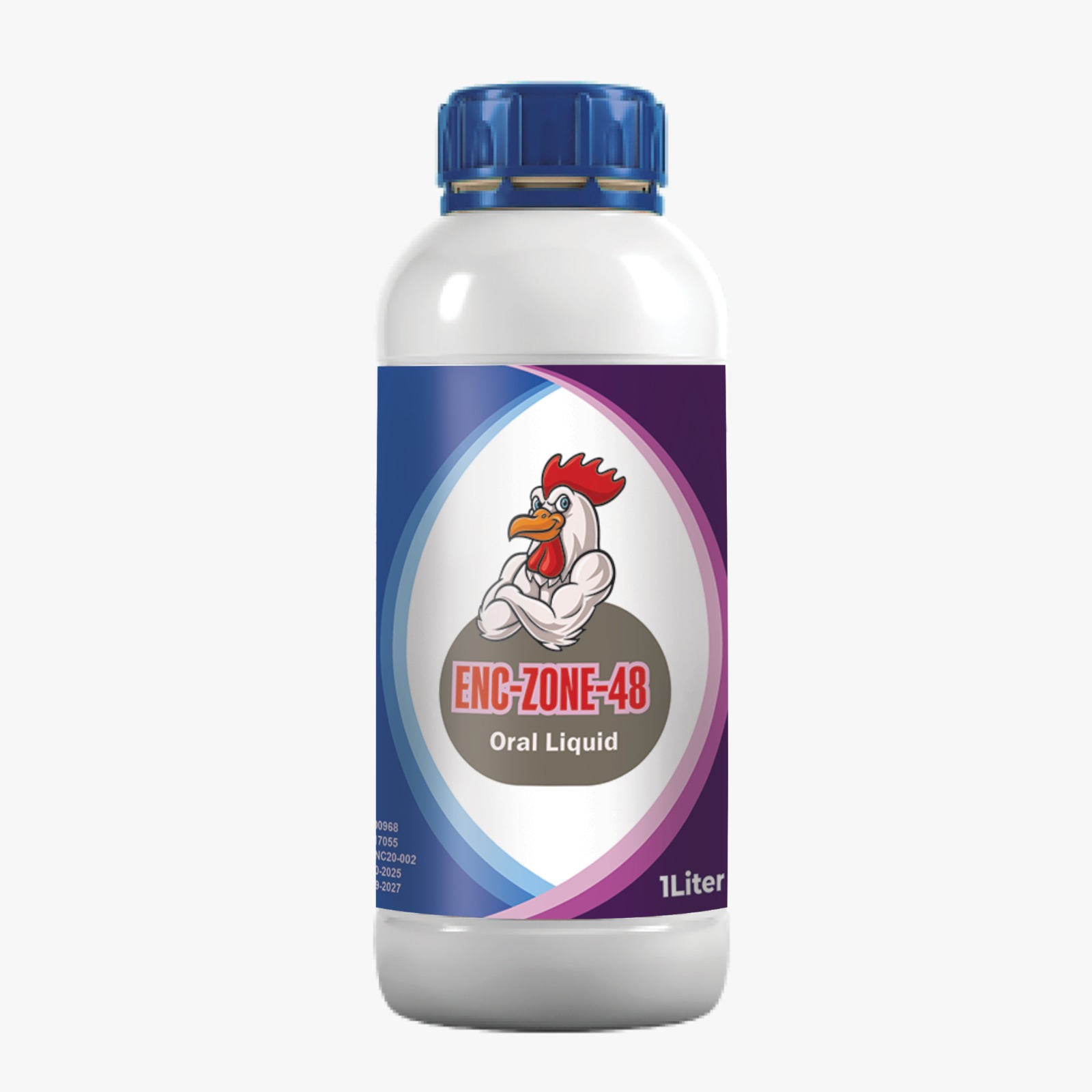
High-concentration combination antibiotic oral solution for poultry containing 10% enrofloxacin (100 mg/ml) and colistin sulfate (48 MIU/ml). Provides synergistic broad-spectrum bactericidal activity against gram-negative and gram-positive bacteria, particularly effective against E. coli, Salmonella, and Mycoplasma infections.
Product Name: ENC-ZONE 48
Type: Oral Liquid Solution - Antibiotic Combination
COMPOSITION
Each ml contains:
- Enrofloxacin (BP Vet) ...... 100 mg (10% w/v)
- Colistin Sulfate BP ...... 48 MIU (Million International Units)
DESCRIPTION
ENC-ZONE 48 is a broad-spectrum antibiotic oral solution combining enrofloxacin (10%) and colistin sulfate for the treatment of bacterial infections in poultry. This synergistic combination provides enhanced antibacterial activity against both gram-positive and gram-negative pathogens, making it one of the most commonly used antibiotic combinations in poultry production worldwide
Enrofloxacin is a synthetic broad-spectrum antibiotic belonging to the fluoroquinolone group. It inhibits the activity of bacterial DNA gyrase (topoisomerase II), an enzyme critical for DNA replication, transcription, and repair, leading to rapid bacterial cell death
Colistin sulfate (polymyxin E) is a polypeptide antibiotic that acts as a surface-active agent, disrupting bacterial cell membrane integrity by interacting with phospholipids, leading to increased permeability and cell lysis
MECHANISM OF ACTION
Enrofloxacin:
- Inhibits bacterial DNA gyrase (topoisomerase II), preventing DNA supercoiling and replication
- Disrupts DNA transcription and repair processes
- Exhibits concentration-dependent bactericidal activity
- Partially metabolized in the body to ciprofloxacin, an active metabolite
Colistin Sulfate:
- Acts as a cationic surface-active agent, binding to lipopolysaccharides in the outer membrane of gram-negative bacteria
- Displaces divalent cations (Ca²⁺, Mg²⁺), destabilizing the cell membrane
- Increases membrane permeability, leading to leakage of cellular contents and cell death
- Poorly absorbed from the gastrointestinal tract, exerting its primary effect in the gut lumen
Synergistic Combination:
- Research confirms that the combination of enrofloxacin and colistin provides superior bactericidal activity compared to either agent alone
- Colistin disrupts the outer membrane, potentially facilitating enrofloxacin entry into bacterial cells
- In vitro studies demonstrate that enrofloxacin and colistin work in an additive/indifferent manner when combined, with no antagonism observed
- The combination helps prevent the emergence of mutants with reduced susceptibility to fluoroquinolone antibiotics
INDICATIONS
ENC-ZONE 48 is indicated for the treatment and control of diseases caused by bacteria sensitive to enrofloxacin and colistin sulfate in poultry
Target Pathogens:
- Escherichia coli - including avian pathogenic E. coli (APEC) causing colibacillosis
- Salmonella spp. - including Salmonella Gallinarum (fowl typhoid) and Salmonella Pullorum (pullorum disease)
- Pasteurella multocida - causing fowl cholera
- Haemophilus paragallinarum - causing infectious coryza
- Mycoplasma spp. - Mycoplasma gallisepticum, Mycoplasma synoviae
- Clostridium perfringens - causing necrotic enteritis
- Staphylococcus spp. and Streptococcus spp.
- Klebsiella spp., Proteus spp., Pseudomonas aeruginosa, Bordetella spp., Campylobacter spp.
Disease Conditions:
- Colibacillosis - airsacculitis, pericarditis, perihepatitis, septicemia
- Salmonellosis - fowl typhoid, pullorum disease, paratyphoid infections
- Chronic Respiratory Disease (CRD) - complicated by bacterial infections
- Necrotic Enteritis - Clostridium perfringens infection
- Fowl Cholera - Pasteurella multocida infection
- Infectious Coryza - Haemophilus paragallinarum infection
- Mycoplasmosis - M. gallisepticum and M. synoviae infections
- Secondary bacterial infections associated with viral diseases
PHARMACOKINETIC PROPERTIES
- Enrofloxacin absorption: Well and rapidly absorbed from the gastrointestinal tract, reaching peak concentrations in 1-3 hours. Widely distributed throughout the body, with concentrations in lungs, liver, kidneys, and bones 2-3 times higher than in blood
- Enrofloxacin elimination: Partially metabolized to ciprofloxacin. Excreted primarily in urine and bile
- Colistin absorption: Poorly absorbed from the gastrointestinal tract, with minimal systemic absorption. Exerts its primary bactericidal effect in the gastrointestinal tract
- Colistin elimination: Excreted almost completely in feces
DOSAGE & ADMINISTRATION
ENC-ZONE 48 is administered via drinking water. For optimal results, fresh solution should be prepared daily.
Recommended Dosage:
- Standard Treatment (Broilers, Layers, Breeders, Turkeys): 0.5 ml per liter of drinking water (1 ml per 2 liters) for 3-5 days
- Salmonellosis, Mixed Infections, Chronic Diseases: 1 ml per liter of drinking water for at least 5 days
- Alternative Dosage: 0.1 ml per kg body weight (equivalent to 10 mg enrofloxacin per kg)
Administration Guidelines:
- Calculate total daily water consumption based on flock size, age, and environmental temperature
- Prepare fresh medicated water daily; discard any unused solution after 24 hours
- Ensure medicated water is the only source of drinking water during treatment
- For best results, administer over 4-8 hours; may withhold water for 1-2 hours before treatment to encourage rapid consumption
- Do not use water containing heavy mineral salts, as this may reduce efficacy
- Do not use with bacteriostatic antibiotics (tetracyclines, macrolides, chloramphenicol) due to potential antagonism
SAFETY AND EFFICACY CONSIDERATIONS
Hematological Effects:
- Research indicates that antibiotic treatment, particularly with enrofloxacin, can cause nonbeneficial effects on red blood cell parameters including hematocrit, MCV, MCH, and MCHC
- Both enrofloxacin and colistin have been associated with increased liver enzyme activities (ALT, AST), suggesting potential hepatotoxicity
In Vitro Efficacy:
- In vitro studies demonstrate that enrofloxacin and colistin work in an additive/indifferent manner when combined, with no antagonism observed
- Combination therapy helps prevent the emergence of mutants with reduced susceptibility to fluoroquinolone antibiotics
- The combination is effective against Campylobacter, E. coli, and Salmonella isolates from poultry
Clinical Use Patterns:
- Surveys indicate that enrofloxacin and colistin are among the most frequently used antibacterials in broiler production worldwide
- The combination is widely used by poultry farmers for treatment of E. coli and Salmonella infections
RESISTANCE CONSIDERATIONS
Growing Concern:
- Antimicrobial resistance is an increasing concern in poultry production. Studies show that enrofloxacin and colistin use can select for resistance not only to themselves but also to other antibiotic classes
- Research demonstrates that enrofloxacin administration increases antimicrobial resistance to enrofloxacin itself, as well as to beta-lactams, tetracycline, and colistin
- Colistin administration increases resistance to colistin itself, as well as to enrofloxacin and beta-lactams
Responsible Use Recommendations:
- Veterinary consultation and susceptibility testing are recommended where available
- Use combination therapy to reduce the risk of resistance development
- Adhere strictly to recommended dosages and treatment durations; avoid subtherapeutic dosing
- Consider alternative strategies such as phage therapy, which studies suggest is as effective as antibiotics but safer for the birds and does not induce hepatotoxicity
DRUG INTERACTIONS
- Antagonistic: Do not use concurrently with bacteriostatic antibiotics (tetracyclines, macrolides, chloramphenicol, lincosamides) due to potential antagonistic effects
- Interactions: Avoid concurrent use with theophylline, polyether ionophores, nonsteroidal anti-inflammatory drugs, and magnesium/calcium supplements
- Nephrotoxicity: Avoid combination with other nephrotoxic drugs (aminoglycosides, cephalosporins)
- Synergistic: Colistin enhances the efficacy of enrofloxacin by disrupting bacterial cell membranes
CONTRAINDICATIONS & PRECAUTIONS
- Egg production: Do not use in laying hens producing eggs for human consumption. Not recommended for use in replacement chickens less than 2 weeks before the start of egg laying due to enrofloxacin accumulation in eggs
- Liver and kidney dysfunction: Do not use in animals with impaired hepatic or renal function
- Hypersensitivity: Do not use in animals with known hypersensitivity to fluoroquinolones or polymyxin antibiotics
- Young birds: Use with caution in very young chicks; consult veterinary guidance
- Immunocompromised animals: Use with caution in animals with compromised immune function
- Keep out of reach of children
- Store in a cool, dry place away from direct sunlight
- Shake well before use
- Use within 28 days after first opening
ADVERSE REACTIONS
- In animals with hypersensitivity: convulsions, tremor, vomiting, anorexia, hemolytic anemia may occur
- All members of the quinolone family of antibiotics have the ability to cause articular lesions in young animals
- Digestive alterations may appear, such as intestinal dysbiosis, accumulation of gases, mild diarrhea or vomiting
- In case of overdose: excitation followed by apathy, rapid breathing (polypnea), and rapid heartbeat may occur
- If adverse reactions occur, discontinue use and consult a veterinarian
WITHDRAWAL PERIOD
- Meat (Poultry): 11 days (based on regulatory standards for enrofloxacin-colistin combinations)
- Eggs: Not for use in laying hens producing eggs for human consumption
- Note: Withdrawal periods may vary by country; always follow local regulatory requirements
STORAGE
- Store in a cool, dry place below 30°C
- Protect from direct sunlight and freezing
- Keep container tightly closed when not in use
- Do not freeze
Target Species: Poultry (Broilers, Layers, Breeders, Turkeys, Ducks, Geese, Pigeons, Quail)
Pack Sizes: 1 Liter HDPE bottle
PRODUCT SUMMARY
ENC-ZONE 48 Liquid Antibiotic Enrofloxacin (BP Vet) 100mg, Colistin Sulphate BP 48 MIU per ml Poultry 1 Liter
FOR VETERINARY USE ONLY