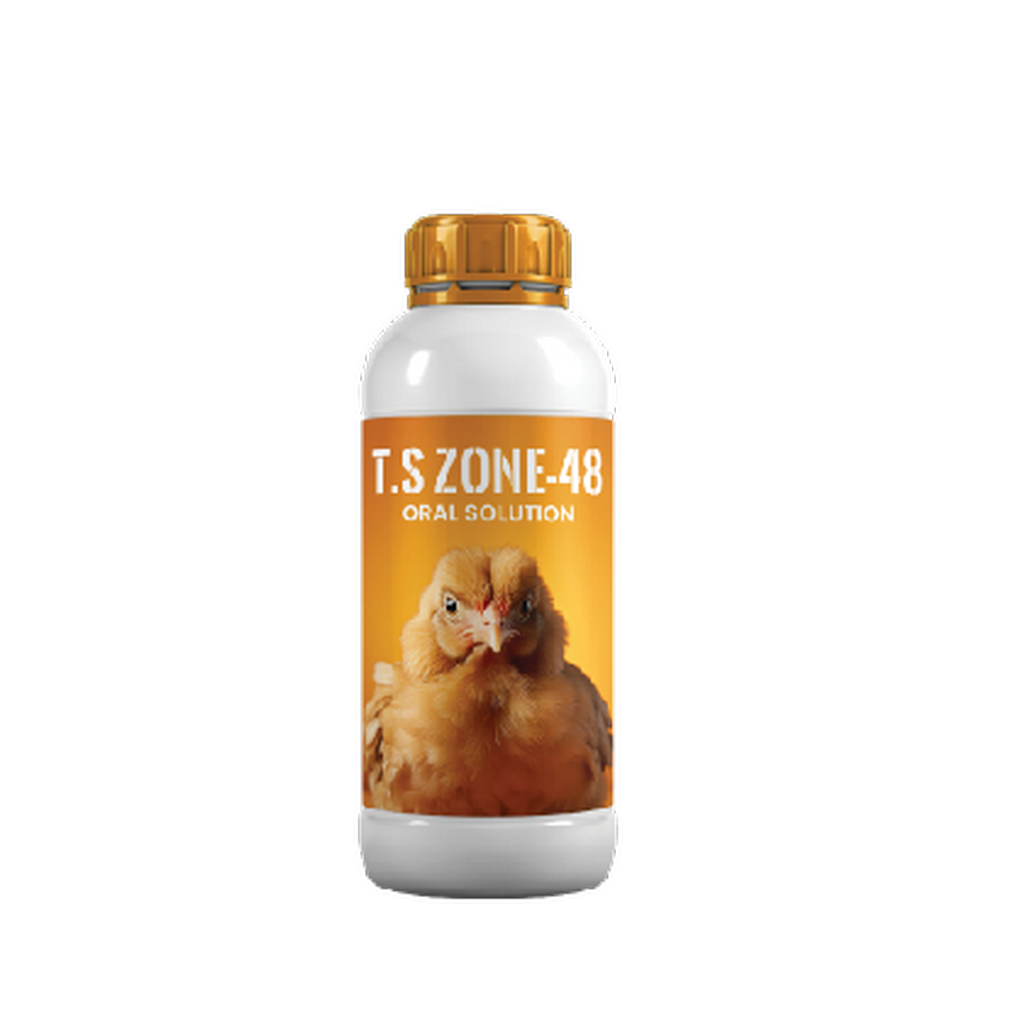
Combination antibiotic oral solution for poultry containing trimethoprim (8%) and sulfadiazine (40%). Provides synergistic bactericidal activity against a broad spectrum of gram-positive and gram-negative bacteria via dual folate pathway blockade.
Product Name: T.S ZONE 48
Type: Oral Liquid Solution - Antibiotic Combination
COMPOSITION
Each 100 ml contains:
- Trimethoprim (BP) ...... 8 g (8% w/v)
- Sulfadiazine (BP) ...... 40 g (40% w/v)
Trimethoprim:Sulfadiazine ratio = 1:5
DESCRIPTION
T.S ZONE 48 is a broad-spectrum antibiotic oral solution combining trimethoprim and sulfadiazine in the optimal 1:5 ratio for the treatment of bacterial infections in poultry. This combination is one of the most widely used and well-documented antibiotic formulations in veterinary medicine .
Trimethoprim and sulfadiazine act synergistically through sequential inhibition of bacterial folate metabolism. Sulfadiazine inhibits the incorporation of para-aminobenzoic acid (PABA) into dihydrofolic acid, while trimethoprim inhibits the enzyme dihydrofolate reductase (DHFR) which converts dihydrofolic acid into tetrahydrofolic acid . This dual blockade is bactericidal, disrupting the synthesis of purines required for DNA synthesis .
MECHANISM OF ACTION
Sulfadiazine:
- Competitively inhibits the enzyme dihydropteroate synthase
- Blocks the incorporation of para-aminobenzoic acid (PABA) into dihydrofolic acid
- Prevents bacterial folic acid synthesis, a critical cofactor for nucleic acid production
Trimethoprim:
- Inhibits bacterial dihydrofolate reductase (DHFR)
- Prevents conversion of dihydrofolic acid to tetrahydrofolic acid
- Disrupts synthesis of essential amino acids, purines, and ultimately DNA
Synergistic Combination:
- Trimethoprim and sulfadiazine act together with a double-blockade mode of action
- The combination is bactericidal, while either agent alone is typically bacteriostatic
- The 1:5 ratio of trimethoprim to sulfadiazine is well documented for optimal veterinary use
- This ratio is associated with a high degree of synergy due to similar pharmacokinetics and sequential enzymatic inhibition
INDICATIONS
T.S ZONE 48 is indicated for the treatment and control of diseases caused by bacteria sensitive to trimethoprim-sulfadiazine in poultry .
Target Pathogens:
- Escherichia coli - causing colibacillosis
- Salmonella spp. - Salmonella Gallinarum (fowl typhoid), Salmonella Pullorum (pullorum disease)
- Pasteurella multocida - causing fowl cholera
- Haemophilus paragallinarum - causing infectious coryza
- Bordetella avium - causing turkey coryza
- Staphylococcus spp. and Streptococcus spp.
- Clostridium spp.
- Klebsiella spp., Proteus spp., Enterobacter spp., Actinobacillus spp., Vibrio spp.
Disease Conditions:
- Colibacillosis - airsacculitis, pericarditis, perihepatitis, septicemia
- Salmonellosis - fowl typhoid, pullorum disease, paratyphoid infections
- Fowl Cholera - Pasteurella multocida infection
- Infectious Coryza - Haemophilus paragallinarum infection
- Turkey Coryza - Bordetella avium infection
- Coccidiosis - as an adjunctive therapy (combination with coccidiostats may be beneficial)
- Secondary bacterial infections associated with viral diseases
- Respiratory and gastrointestinal tract infections of bacterial origin
PHARMACOKINETIC PROPERTIES
- Sulfadiazine: Rapidly absorbed after oral administration. Low protein binding (approximately 20-30%) and widely distributed throughout the body. Easily passes through the blood-brain barrier, achieving high concentrations in cerebrospinal fluid . Metabolized in the liver to acetylated derivatives; excreted primarily by glomerular filtration. Plasma half-life in poultry: approximately 4-8 hours
- Trimethoprim: Well absorbed from the gastrointestinal tract. Approximately 65% protein bound but, being lipid soluble, readily penetrates cellular barriers for wide distribution . Partially oxidized and conjugated in the liver; metabolites and unchanged drug excreted in urine. Plasma half-life in poultry: approximately 3-6 hours
- Synergistic Compatibility: While the half-lives of the two compounds vary across species, synergism occurs over a wide range of dose ratios. The 1:5 trimethoprim:sulfadiazine ratio is well documented for optimal veterinary efficacy
DOSAGE & ADMINISTRATION
T.S ZONE 48 is administered via drinking water. For optimal results, fresh solution should be prepared daily.
Recommended Dosage:
- Standard Treatment: 0.5 - 1 ml per liter of drinking water
- Treatment Duration: 3-5 consecutive days
- Alternative Dosage (based on body weight): 0.2-0.3 ml per kg body weight (equivalent to 48-72 mg of the combination per kg)
- For Coccidiosis: Two treatments of 3 days, interposed by 2 days of suspension
Administration Guidelines:
- Calculate total daily water consumption based on flock size, age, and environmental temperature
- Prepare fresh medicated water daily; discard any unused solution after 24 hours
- Ensure medicated water is the only source of drinking water during treatment
- For best results, administer over 4-8 hours; may withhold water for 1-2 hours before treatment to encourage rapid consumption
- Do not use with acidic water or acidic drugs (e.g., vitamin C, calcium chloride, penicillin) as this may cause crystallization
- Do not remix once dissolved as there is a risk of crystallization at strong concentrations
- After treatment, clean the water supply system thoroughly to avoid subtherapeutic dosing
- Ensure an abundant supply of fresh water throughout the treatment period
ANTIMICROBIAL SPECTRUM
The trimethoprim-sulfadiazine combination exhibits broad-spectrum activity against:
- Gram-negative bacteria: E. coli, Salmonella spp., Pasteurella spp., Haemophilus spp., Klebsiella spp., Proteus spp., Enterobacter spp., Bordetella spp., Vibrio spp., Actinobacillus spp., Brucella spp.
- Gram-positive bacteria: Staphylococcus spp., Streptococcus spp., Clostridium spp., Corynebacterium spp., Arcanobacterium spp.
- Protozoa: Coccidia (Eimeria spp.) - combination therapy may be beneficial in coccidiosis cases
EFFICACY AND RESIDUE STUDIES
Residue Depletion Study:
- A controlled study on residue depletion of sulfadiazine and trimethoprim in broilers after oral administration (300 mg/kg sulfadiazine and 60 mg/kg trimethoprim in feed for 5 days) established that to ensure safe residue levels in all target tissues, a withdrawal time of 6.0 days should be applied for broilers treated with the combination
Clinical Efficacy:
- The combination has been extensively documented for its efficacy against respiratory and gastrointestinal infections in poultry, with numerous products registered worldwide containing sulfadiazine and trimethoprim in similar concentrations
- The combination is effective against both gram-positive and gram-negative pathogens, making it suitable for mixed bacterial infections
- In cases of coccidiosis, the combination is often used alongside specific coccidiostats or in alternating treatment protocols
DRUG INTERACTIONS
- Acidic drugs: Avoid concurrent use with vitamin C, calcium chloride, penicillin, and other acidic substances as they may cause crystallization and reduce solubility
- Bactericidal antibiotics: Sulfonamides may antagonize the bactericidal activity of penicillins; use with caution
- Vitamin K: In cases of prolonged therapy, supplementation with vitamin K is recommended to prevent bleeding tendencies that may occur with sulfonamide use
- B vitamins: B vitamin supplementation is recommended during extended treatment periods as sulfonamides may interfere with bacterial synthesis of these vitamins in the gut
CONTRAINDICATIONS & PRECAUTIONS
- Egg production: Do not use in laying hens producing eggs for human consumption. Sulfonamides can accumulate in eggs and pose a food safety risk
- Hypersensitivity: Do not use in animals with known hypersensitivity to sulfonamides or trimethoprim
- Liver and kidney impairment: Use with caution or avoid in animals with impaired hepatic or renal function
- Crystalluria: Ensure adequate water intake during treatment to prevent crystal formation in the kidneys. In hot climates where water consumption increases, adhere to minimum dosage recommendations to avoid overdose
- Antimicrobial resistance: Use should be based on bacterial susceptibility testing when possible. Improper use may increase the prevalence of resistant bacteria and may decrease the efficacy of other antimicrobials due to potential cross-resistance
- Keep out of reach of children
- Store in a cool, dry place below 25-30°C, protected from direct sunlight
- Shake well before use
- Use within 28 days after first opening
ADVERSE REACTIONS
- Sulfonamides may cause crystalluria and potential kidney damage if water intake is inadequate
- Prolonged use may cause folic acid deficiency, leading to hematological changes
- In hypersensitive animals, allergic reactions, skin rashes, or fever may occur
- If adverse reactions occur, discontinue use and consult a veterinarian
WITHDRAWAL PERIOD
- Meat (Poultry): 5-8 days (varies by regulatory jurisdiction; typical withdrawal: 5-7 days)
- Eggs: Not for use in laying hens producing eggs for human consumption
- Note: Withdrawal periods may vary by country; always follow local regulatory requirements. Residue studies indicate that a 6-day withdrawal period ensures safe residue levels in all target tissues
STORAGE
- Store in a cool, dry place below 25-30°C
- Protect from direct sunlight and freezing
- Keep container tightly closed when not in use
- Do not freeze
- If crystallization occurs at low temperatures, warm gently to redissolve before use
Target Species: Poultry (Broilers, Turkeys, Ducks, Geese, Pigeons, Quail) - Not for use in laying hens
Pack Sizes: 1 Liter HDPE bottle
PRODUCT SUMMARY
T.S ZONE 48 Liquid Antibiotic Trimethoprim (BP) 8g, Sulphadiazine (BP) 40g per 100ml Poultry 1 Liter
FOR VETERINARY USE ONLY