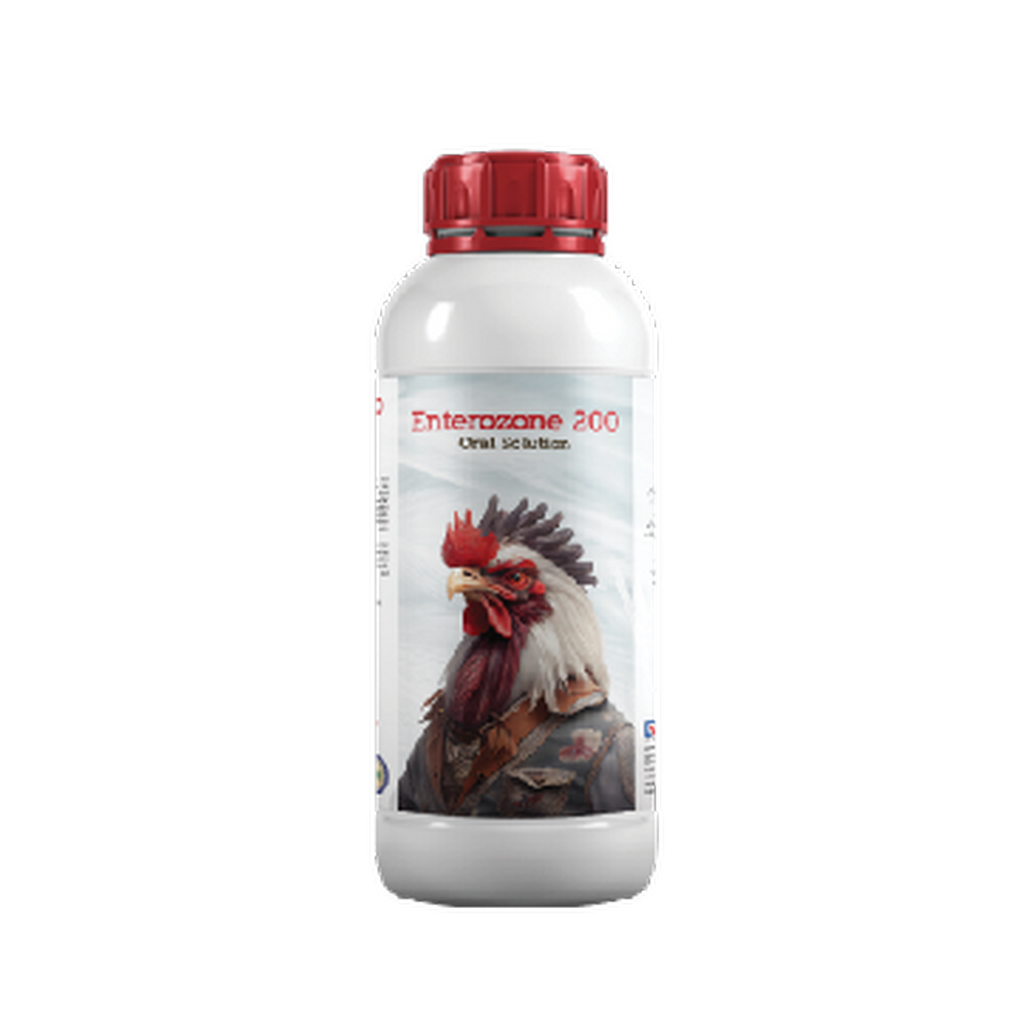
Concentrated colistin sulfate antibiotic oral solution for poultry. Contains 2000 MIU per 1000ml (2 MIU per ml). Provides targeted bactericidal activity against gram-negative enteric pathogens including E. coli, Salmonella, and other colistin-sensitive bacteria causing gastrointestinal infections.
Product Name: ENTEROZONE 200
Type: Oral Liquid Solution - Polypeptide Antibiotic
COMPOSITION
Each 1000 ml contains:
- Colistin Sulfate BP ...... 2000 MIU (Million International Units)
Each ml contains 2 MIU of colistin sulfate activity.
DESCRIPTION
ENTEROZONE 200 is a concentrated, broad-spectrum antibiotic oral solution containing colistin sulfate (polymyxin E), a polypeptide antibiotic derived from Bacillus polymyxa
Colistin is a bactericidal antibiotic that exerts its effect by acting as a cationic surface-active agent, interacting with phospholipids in the bacterial cell membrane . This interaction disrupts membrane integrity, increases permeability, and leads to leakage of essential cellular contents, ultimately causing bacterial cell death .
Colistin is poorly absorbed from the gastrointestinal tract, making it particularly effective for treating enteric (intestinal) infections while minimizing systemic exposure .
MECHANISM OF ACTION
Colistin sulfate works through a unique bactericidal mechanism:
- Binds to lipopolysaccharides and phospholipids in the outer membrane of gram-negative bacteria
- Displaces divalent cations (Ca²⁺, Mg²⁺), destabilizing the cell membrane structure
- Increases membrane permeability, causing leakage of intracellular contents
- Results in rapid bacterial cell death
- Poorly absorbed from the gastrointestinal tract, exerting its primary effect in the intestinal lumen
INDICATIONS
ENTEROZONE 200 is indicated for the treatment and control of gastrointestinal infections in poultry caused by gram-negative bacteria sensitive to colistin sulfate
Target Pathogens:
- Escherichia coli - colibacillosis, enteritis, septicemia
- Salmonella spp. - salmonellosis, paratyphoid, fowl typhoid, pullorum disease
- Shigella spp.
- Klebsiella spp.
- Proteus spp.
- Pseudomonas aeruginosa
- Pasteurella multocida - fowl cholera (enteric form)
- Haemophilus spp., Bordetella spp., Aerobacter aerogenes
Disease Conditions:
- Colibacillosis - diarrhea, enteritis, yolk sac infection, airsacculitis
- Salmonellosis - fowl typhoid, pullorum disease, paratyphoid
- Enteritis and Enterotoxic Syndrome - bacterial diarrhea
- Reduction of early mortality in chicks
- Secondary bacterial enteritis associated with viral or parasitic diseases
ANTIMICROBIAL SPECTRUM
Colistin exhibits potent bactericidal activity primarily against aerobic gram-negative bacilli:
- Highly Susceptible: E. coli, Salmonella spp., Shigella spp., Klebsiella spp., Aerobacter aerogenes
- Moderately Susceptible: Pseudomonas aeruginosa, Pasteurella multocida, Haemophilus spp., Bordetella spp.
- Resistant: Gram-positive bacteria, Proteus spp. (variable), Serratia spp., anaerobic bacteria
PHARMACOKINETIC PROPERTIES
- Absorption: Poorly absorbed from the gastrointestinal tract; minimal systemic bioavailability
- Distribution: Concentrates in the intestinal tract where it exerts its antibacterial effect
- Elimination: Excreted almost completely in feces, primarily unchanged
- Advantage: Low systemic absorption means minimal risk of tissue residues and reduced systemic toxicity
DOSAGE & ADMINISTRATION
ENTEROZONE 200 is administered via drinking water. For optimal results, fresh solution should be prepared daily.
Recommended Dosage:
- Poultry (Broilers, Layers, Breeders, Turkeys, Ducks, Geese): 0.25 - 0.5 ml per liter of drinking water (equivalent to 1 ml per 2-4 liters)
- Treatment Duration: 3-7 consecutive days
- Alternative Dosage (based on activity): 75,000-100,000 IU of colistin per kg body weight per day
Dosage Based on Colistin Activity:
- Prevention: 20-40 mg colistin sulfate per kg feed (approximately 20-400 g per ton of feed)
- Treatment: 75-100 mg colistin sulfate per kg feed (approximately 750-1,000 g per ton of feed)
Administration Guidelines:
- Calculate total daily water consumption based on flock size, age, and environmental temperature
- Prepare fresh medicated water daily; discard any unused solution after 24 hours
- Ensure medicated water is the only source of drinking water during treatment
- For best results, administer over 4-8 hours; may withhold water for 1-2 hours before treatment to encourage rapid consumption
- Only sufficient medicated drinking water should be prepared to cover daily requirements
- Treatment should be supplemented with proper breeding and zoohygienic procedures to reduce the risk of infection
SYNERGISTIC COMBINATIONS
- Colistin exhibits synergistic effects with a variety of antimicrobial agents, including macrolides, tetracyclines, and bacitracin
- Compatible with antidiarrheal agents (e.g., kaolin, pectin) and vitamins
- No antagonism observed with other antibiotics and anticoccidials during oral administration
- Commonly used in combination with florfenicol or enrofloxacin for enhanced gram-negative coverage
RESISTANCE CONSIDERATIONS
Mechanisms of Resistance:
- Resistance primarily occurs via modification of lipopolysaccharides in the outer membrane
- Plasmid-mediated resistance (mcr genes) has emerged as a global concern
- Cross-resistance with other polymyxins may occur
Responsible Use:
- Veterinary consultation and susceptibility testing are recommended where available
- Do not use in subtherapeutic doses
- Adhere strictly to recommended dosages and treatment durations
- Colistin is considered a critically important antibiotic for human medicine; its use in animals should be judicious and limited to treatment of confirmed susceptible infections
- Avoid use in cases of known resistance to colistin
CONTRAINDICATIONS & PRECAUTIONS
- Hypersensitivity: Do not use in animals with known hypersensitivity to colistin or polymyxin antibiotics
- Renal impairment: Use with caution or avoid in animals with impaired renal function, as colistin is primarily excreted renally when absorbed
- Egg production: Do not use in laying hens producing eggs for human consumption (withdrawal period applies for meat; eggs are typically nil withdrawal if used during non-laying period)
- Ruminants: Not for use in ruminating animals with active microbial digestion; for pre-ruminant calves, lambs, and kids only
- Keep out of reach of children
- Store in a cool, dry place below 30°C, protected from direct sunlight
- Shake well before use
- Use within 28 days after first opening
ADVERSE REACTIONS
- Poorly absorbed orally, therefore systemic toxicity is minimal at recommended doses
- Nephrotoxicity and neurotoxicity are rare with oral administration at therapeutic doses but may occur with systemic absorption at very high doses
- Digestive disturbances such as mild diarrhea may occur in some animals
- If adverse reactions occur, discontinue use and consult a veterinarian
WITHDRAWAL PERIOD
- Meat (Poultry): 7 days
- Eggs: Zero days (nil withdrawal)
- Note: Withdrawal periods may vary by regulatory jurisdiction; always follow local requirements
STORAGE
- Store in a cool, dry place below 30°C
- Protect from direct sunlight and freezing
- Keep container tightly closed when not in use
- Do not freeze
Target Species: Poultry (Broilers, Layers, Breeders, Turkeys, Ducks, Geese, Quail, Pigeons)
Pack Sizes: 1 Liter HDPE bottle
PRODUCT SUMMARY
ENTEROZONE 200 Liquid Antibiotic Colistin Sulphate BP 2000 MIU per 1000ml Poultry 1 Liter
FOR VETERINARY USE ONLY