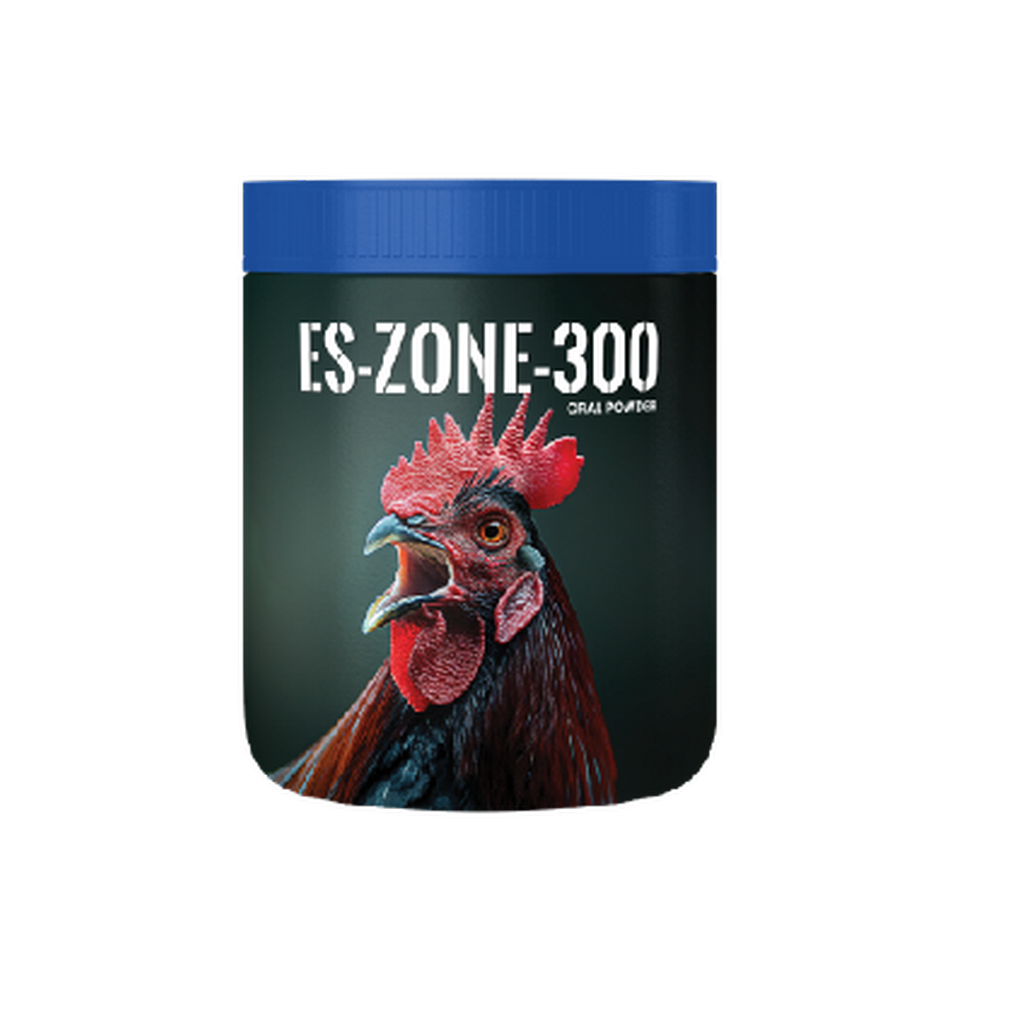
Sulfachloropyrazine sodium 30% water-soluble powder for poultry. Contains 300 mg/g for treatment of coccidiosis caused by Eimeria species, as well as fowl typhoid (Salmonella gallinarum) and fowl cholera (Pasteurella multocida) in chickens, turkeys, ducks, and rabbits.
Product Name: ES-ZONE 300
Type: Oral Water-Soluble Powder - Anticoccidial & Antibacterial (Sulfonamide)
COMPOSITION
Each 100 g contains:
- Sulfachloropyrazine Sodium (as Sulfaclozine Sodium Monohydrate USP) ...... 30 g (30% w/w, 300 mg per gram)
Sulfachloropyrazine sodium is also known as sulfaclozine sodium or sulphaclozine sodium.
DESCRIPTION
ES-ZONE 300 is a water-soluble anticoccidial and antibacterial powder containing 30% sulfachloropyrazine sodium, a sulfonamide derivative with potent activity against coccidial parasites and susceptible bacteria. This product is widely used in poultry for the treatment and control of coccidiosis, as well as bacterial infections such as fowl typhoid and fowl cholera .
Sulfachloropyrazine sodium (sulfaclozine sodium) is a broad-spectrum sulfonamide that acts by inhibiting bacterial and protozoal folate synthesis through competitive antagonism of para-aminobenzoic acid (PABA), disrupting nucleic acid production. This mechanism is particularly effective against coccidial species during the early stages of their life cycle .
MECHANISM OF ACTION
Sulfachloropyrazine sodium exerts its effects through competitive inhibition of the enzyme dihydropteroate synthase in the folic acid synthesis pathway. By structurally mimicking para-aminobenzoic acid (PABA), it competitively blocks the incorporation of PABA into dihydrofolic acid, thereby preventing the synthesis of tetrahydrofolic acid, an essential cofactor for nucleic acid production. This inhibition disrupts DNA synthesis and cell division in susceptible microorganisms, including coccidial parasites and bacteria .
The drug is rapidly absorbed after oral administration and achieves therapeutic concentrations in the intestinal tract where coccidial parasites reside. It is particularly effective against the schizont stage of Eimeria species .
INDICATIONS
ES-ZONE 300 is indicated for the treatment and control of the following conditions in poultry and livestock:
Coccidiosis:
- Treatment of coccidiosis in chickens, turkeys, ducks, and rabbits caused by susceptible Eimeria species, including Eimeria tenella (caecal coccidiosis), Eimeria necatrix, Eimeria acervulina, Eimeria brunetti, Eimeria maxima, Eimeria adenoides, Eimeria mitis, and Eimeria meleagrimitis
- Particularly effective against acute outbreaks of caecal coccidiosis with bloody diarrhea and mortality
Bacterial Infections:
- Fowl Typhoid - caused by Salmonella gallinarum
- Fowl Cholera - caused by Pasteurella multocida
- Colibacillosis - caused by Escherichia coli
- Other sulfonamide-sensitive bacterial infections in poultry
DOSAGE & ADMINISTRATION
ES-ZONE 300 is administered via drinking water or mixed with feed. For optimal results, fresh medicated water should be prepared daily.
Recommended Dosage:
Poultry (Chickens, Turkeys, Ducks):
- Drinking Water: 1 g per liter of drinking water (providing 300 mg active ingredient per liter) for 3-5 consecutive days
- Severe Infections: 1.5-2 g per liter of drinking water for 3-5 days
- Feed Mixing: 2 kg per ton of feed (2 g per kg feed) for 3-5 days
Rabbits:
- Feed Mixing: 2 g per kg of feed (2 kg per ton) for 5-10 consecutive days
Sheep:
- Oral Administration: 0.4 g per kg body weight daily for 3-5 consecutive days
Preventive (Control) Program:
- Broilers: 1 g per liter of drinking water at 3 weeks of age (first treatment) and at 5 weeks of age (second treatment), each for 3 consecutive days
- Layers: 1 g per liter of drinking water at 3 weeks, 5 weeks, and at the start of laying, each for 3 consecutive days
Administration Guidelines:
- Dissolve the required amount of ES-ZONE 300 in a small volume of water, then add to the main drinking water tank
- For use in automatic water proportioners, prepare stock solution according to manufacturer specifications
- Fresh medicated drinking water should be provided daily; discard any unused solution after 24 hours
- Ensure medicated water is the sole source of drinking water during treatment
- The feed and drinking water should be doubled for the first three days of treatment to ensure adequate intake
- For severe infections (E. tenella, E. necatrix), the higher dosage range (1.5-2 g/L) is recommended
EFFICACY AND RESISTANCE CONSIDERATIONS
Efficacy Data:
- A 2025 study published in Veterinary Medicine and Science evaluated the efficacy of sulphaclozine (2 g/L) against seven field isolates of Eimeria tenella in broiler chickens. The findings revealed that resistance to sulphaclozine was evident in all isolates tested, indicating that caution is warranted in regions where this drug has been used extensively .
- Historical studies have shown that sulfachloropyrazine sodium (Esb3) effectively reduces mortality during acute coccidiosis outbreaks. One study reported that Esb3 reduced mortality from 5.7% to 2.3% during outbreaks of caecal coccidiosis .
- Toltrazuril has been identified as the most effective anticoccidial drug in recent studies, with sulphaclozine showing varying levels of efficacy depending on regional resistance patterns .
Resistance Considerations:
- Prolonged or repeated use of sulfonamide anticoccidials can lead to the development of drug-resistant Eimeria strains
- Resistance to sulphaclozine has been documented in several countries, emphasizing the importance of judicious use and rotation with other anticoccidial drug classes
- To preserve drug efficacy, avoid long-term continuous use and consider alternating with other anticoccidials such as toltrazuril, amprolium, or ionophores
- Veterinary consultation and, where possible, susceptibility testing are recommended for effective treatment selection
WITHDRAWAL PERIOD
- Meat (Chickens): 1 day (for treatment at recommended dosage)
- Meat (Turkeys): 4 days
- Eggs: Do not use in chickens producing eggs for human consumption
- Note: A residue depletion study showed that a maximum withdrawal time of 14 days was calculated to ensure consumer safety for sulfachlorpyrazine residues. However, the 1-day withdrawal for chickens is based on approved label recommendations. Always follow local regulatory requirements .
CONTRAINDICATIONS & PRECAUTIONS
- Egg production: Do not use in laying hens producing eggs for human consumption
- Hypersensitivity: Do not use in animals with known hypersensitivity to sulfonamides
- Liver and kidney dysfunction: Use with caution in animals with impaired hepatic or renal function
- Dehydration: Ensure adequate water intake during treatment to prevent crystalluria
- Long-term use: Prolonged use may result in vitamin K deficiency and bleeding tendencies; vitamin K supplementation may be considered
- Resistance: It is forbidden to use long-term as an additive in feedstuffs
- Keep out of reach of children
- Store in a cool, dry place below 25-30°C, protected from direct sunlight
- Protect from moisture
- Use within 28 days after first opening
ADVERSE REACTIONS
- Long-term excessive application may produce sulfa drug poisoning symptoms including depression, reduced feed intake, and crystalluria
- Symptoms will generally disappear after drug withdrawal
- If adverse reactions occur, discontinue use and consult a veterinarian
STORAGE
- Store in a cool, dry place below 25-30°C
- Protect from direct sunlight and moisture
- Keep container tightly closed when not in use
- Do not freeze
Target Species: Chickens (Broilers, Layers, Breeders), Turkeys, Ducks, Rabbits, Sheep
Pack Sizes: 1 Kg HDPE container
PRODUCT SUMMARY
ES-ZONE 300 Powder Antibiotic Sulphaclozine sodium as Sulphachloropyrazine sodium monohydrate USP 30g per 100g Poultry 1 Kg
FOR VETERINARY USE ONLY